New features:
New developmental learning rubric
The two organising strands of knowledge and skills are interrelated and should be taught in an integrated way. We have re-engineered the Learning ladder and the question blocks to help all students build a deep and expanding understanding of content, concepts and skills. The language in the rubric has been simplified to make it more accessible to students.
Revised How-to
Both the History and Geography How-to describe and model each of the steps in the skills Learning ladder, providing scaffolding for students at all entry points as well as opportunities for differentiated instruction.
Inquiry
Scaffolded inquiry activities at the end of every chapter build curiosity and capacity to develop and answer questions. Both the History and Geography How-to sections now include a step-by-step guide to formulating good questions, undertaking research and communicating.
More content
Civics and citizenship and Economics and business have now been included in the printed Student book and more topics have been added, including Ancient India and Renaissance Italy. Brand-new content has been developed for Emergence of the modern world in Europe, Indonesia, and Regional and global conflict.
Good Humanities uses developmental frameworks to scaffold progression. Each chapter has been crafted around rubrics that allow students to understand and chart their own progress, and provides differentiation opportunities for teachers.
Our expert First Nations educators have authored engaging new content about significant Aboriginal and Torres Strait Islander Peoples’ beliefs and values that shaped, and continue to shape, culture, community and relationships with Country.
Year 8 book contents:
Europe and the Mediterranean world (c. 60–1750 CE)
Asia and the Pacific region (c. 60–1750 CE)
Landforms and landscapes
Changing nations
Laws and citizens
Business and entrepreneurship
Work
New features:
New developmental learning rubric
The two organising strands of knowledge and skills are interrelated and should be taught in an integrated way. We have re-engineered the Learning ladder and the question blocks to help all students build a deep and expanding understanding of content, concepts and skills. The language in the rubric has been simplified to make it more accessible to students.
Revised How-to
Both the History and Geography How-to describe and model each of the steps in the skills Learning ladder, providing scaffolding for students at all entry points as well as opportunities for differentiated instruction.
Inquiry
Scaffolded inquiry activities at the end of every chapter build curiosity and capacity to develop and answer questions. Both the History and Geography How-to sections now include a step-by-step guide to formulating good questions, undertaking research and communicating.
More content
Civics and citizenship and Economics and business have now been included in the printed Student book and more topics have been added, including Ancient India and Renaissance Italy. Brand-new content has been developed for Emergence of the modern world in Europe, Indonesia, and Regional and global conflict.
Good Humanities uses developmental frameworks to scaffold progression. Each chapter has been crafted around rubrics that allow students to understand and chart their own progress, and provides differentiation opportunities for teachers.
Our expert First Nations educators have authored engaging new content about significant Aboriginal and Torres Strait Islander Peoples’ beliefs and values that shaped, and continue to shape, culture, community and relationships with Country.
Year 9 book contents:
Australia (175–1914)
Australians at war (191–1945)
Asia (175–present)
Biomes and food security
Geographies of interconnection
Government and democracy
Citizenship, identity and diversity
Economic literacy
Consumer and financial literacy
Good Science has been crafted to reflect the new 7–10 Science syllabus for New South Wales with an emphasis on helping students to forge deep understandings, to create connections and to become scientifically literate citizens. It seeks to equip students with the essential knowledge and skills to observe, question, investigate, and analyse, and to tackle familiar and novel problems. It explores the deeply human and cultural dimensions of science and supports students to engage with science-related issues. Students are empowered to develop new capabilities, while teachers can measure progress and set tasks appropriate for each student.
Working scientifically processes, literacy and numeracy are comprehensively supported in the Science How-to section, which provides models and exemplars for students to refer to. Processes, literacy and numeracy are explicitly modelled and cross-referenced, providing students with a ready-reference toolkit.
Good Science has been crafted to reflect the new 7–10 Science curriculum for Victoria with an emphasis on helping students to forge deep understandings, to create connections and to become scientifically literate citizens.
It seeks to equip students with the essential Science understanding and skills to tackle familiar and novel problems.
It explores the deeply human and cultural dimensions of science and supports students to engage with science-related issues.
Students are empowered to develop new capabilities, while teachers can measure progress and set tasks appropriate for each student. Science inquiry skills, science as a human endeavour, scientific writing (including command terms) and maths in science are all unpacked and explicitly modelled and cross- referenced, providing students with a ready-reference toolkit.
Year 7 Table of contents:
1 Introduction to science
2 Classification
3 Ecosystems
4 Theories of matter
5 Mixtures
6 Eart’s resources
7 Earth, the Sun and the Moon
8 Forces and simple machines
Appendix 1 Science How-to: Year 7
Appendix 2 Investigations
Good Science has been crafted to reflect the new 7–10 Science curriculum for Victoria with an emphasis on helping students to forge deep understandings, to create connections and to become scientifically literate citizens.
It seeks to equip students with the essential Science understanding and skills to tackle familiar and novel problems.
It explores the deeply human and cultural dimensions of science and supports students to engage with science-related issues.
Students are empowered to develop new capabilities, while teachers can measure progress and set tasks appropriate for each student. Science inquiry skills, science as a human endeavour, scientific writing (including command terms) and maths in science are all unpacked and explicitly modelled and cross- referenced, providing students with a ready-reference toolkit.
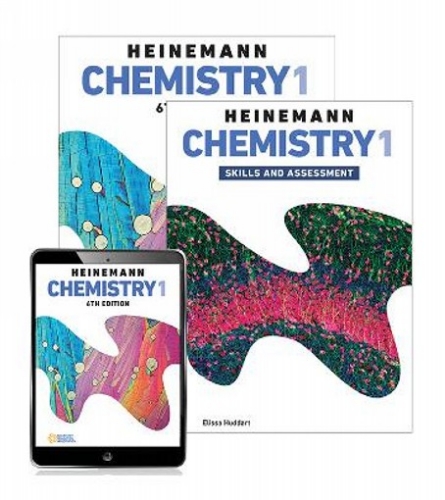
This pack contains 1 copy of
Written to the VCE Chemistry Study Design 2023-2027, the student book incorporates best practice literacy and learning design to ensure the content and concepts are fully accessible to all learners.
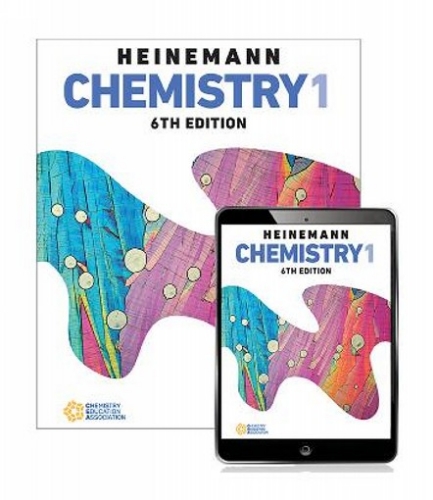
Save time by accessing content and assessment in one simple-to-use platform with the new Heinemann Chemistry 6th edition enhanced eBook +Assessment.
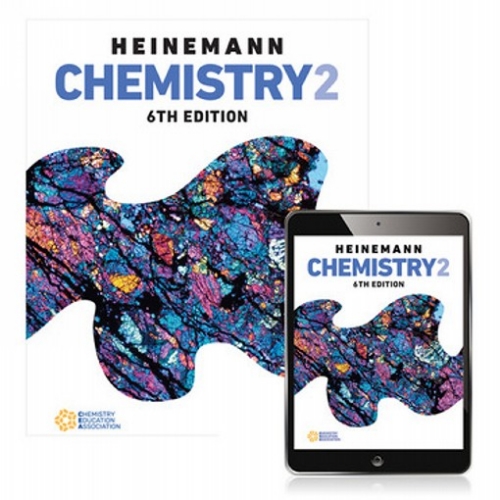
Written to the VCE Chemistry Study Design 2023-2027, the student book incorporates best practice literacy and learning design to ensure the content and concepts are fully accessible to all learners.
Save time by accessing content and assessment in one simple-to-use platform with the new Heinemann Chemistry 6th edition enhanced eBook +Assessment.
Key features of the student book
Key features of the eBook + Assessment
Learner access: